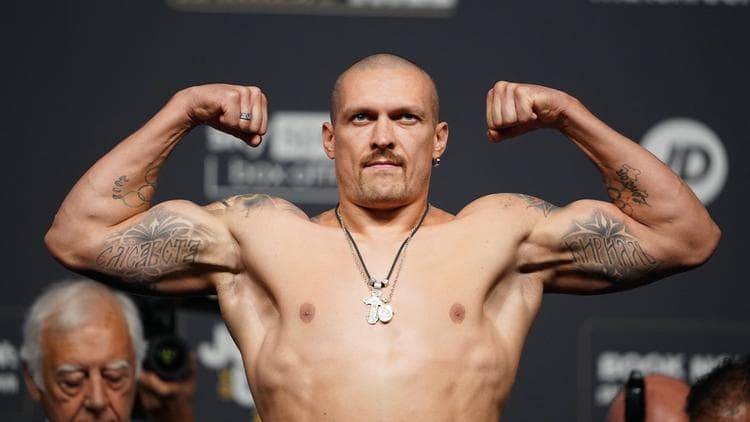
Oleksandr Usyk's run has left the heavyweight division in a rare state of fragility, to the point that the fight between Deontay Wilder and Dereck Chisora mostly served as a revealing picture of the current emptiness.
For ten, maybe even fifteen years, heavyweights have been tied to a certain physical model, almost a caricature of boxing's glamour division. From the Klitschko era through Anthony Joshua, Deontay Wilder, Daniel Dubois, Joseph Parker and Tyson Fury, the division was shaped by gigantic men, very tall, very powerful, sometimes a little stiff in rhythm, but always able to impose an overwhelming sense of physical force. That image stood in contrast with the heavyweights of earlier decades, who were more mobile, more varied, and closer in the collective imagination to figures like Muhammad Ali, Mike Tyson or Lennox Lewis. And yet this generation of giant heavyweights did not always set the public on fire. It often created an impression of robotic power, a form of boxing that was spectacular because of size, but less alive in style, less rich in movement, less surprising in exchanges. It was into exactly that landscape that Usyk arrived. A former cruiserweight, with a respectable frame but nothing extraordinary for a modern heavyweight, he did not fit the prototype that was supposed to rule the division. In theory, he was meant to be the brilliant and courageous technician who would still be too small to fully impose himself at the top. In practice, he beat everyone. He beat Tyson Fury twice, after Fury had beaten Wilder twice. He beat Anthony Joshua twice, even though Joshua remains one of the defining heavyweights of the last fifteen years. He also beat Daniel Dubois twice, even though Dubois had long been presented as part of the division's future. In just a handful of fights, Usyk did not merely win belts or add major names to his resume. He undermined the dominant model of the modern heavyweight itself: the giant supposedly too big, too strong and too physical to be undone by technique, ring intelligence and control of tempo.
The problem is that after his run, there is not much left that feels like an immediate and credible succession. This weekend, the fight between Wilder and Chisora offered a fairly sad image of what remains behind them. Wilder, once technically limited but terrifying because of his right hand, no longer seemed capable of producing what once made him unique. Watching him fail to stop an aging Dereck Chisora, who no longer belongs at the summit of the division, says something about the current decline. And the fact that such a fight can still take up so much media space also shows how badly the division now lacks fresh and credible marquee bouts. One could even argue that the true climax of heavyweight boxing over the last ten years remains the Tyson Fury-Deontay Wilder trilogy. The first fight produced that now-mythic image of Fury rising in the twelfth round after the knockdown. The two that followed extended the same feeling of chaos, swings, drama and pure spectacle. That may have been the division's last truly massive entertainment peak. Then Usyk arrived and swept that whole drama aside with something else: technique, control, composure, and still a very real ability to hurt opponents, as he showed against Fury, Joshua and especially in his second knockout win over Dubois. From there, the question becomes almost brutal: what is left after him? Of course the division will eventually rebuild itself, and there are a few names, like Moses Itauma, who can still create a small sense of hope. But in the short term, the dominant impression is that of a field of ruins. The old reference points are worn out, the old threats no longer frighten anyone, and the next truly big fights are not yet clearly taking shape.
In the end, the point is not only that Usyk dominated his era, but that he left behind a division suddenly stripped bare. He showed that the modern heavyweights, as they had been imagined for the last fifteen years, were not nearly as untouchable as many believed, and the recent Wilder-Chisora spectacle confirmed that a large part of that generation is now deep into its final cycle. Boxing remains full of surprises, especially at heavyweight, so it would be excessive to announce a lasting desert. But one thing is clear: at this moment, the sport's flagship division is going through a striking period of emptiness, and it will probably take time before it recovers a real sporting promise.