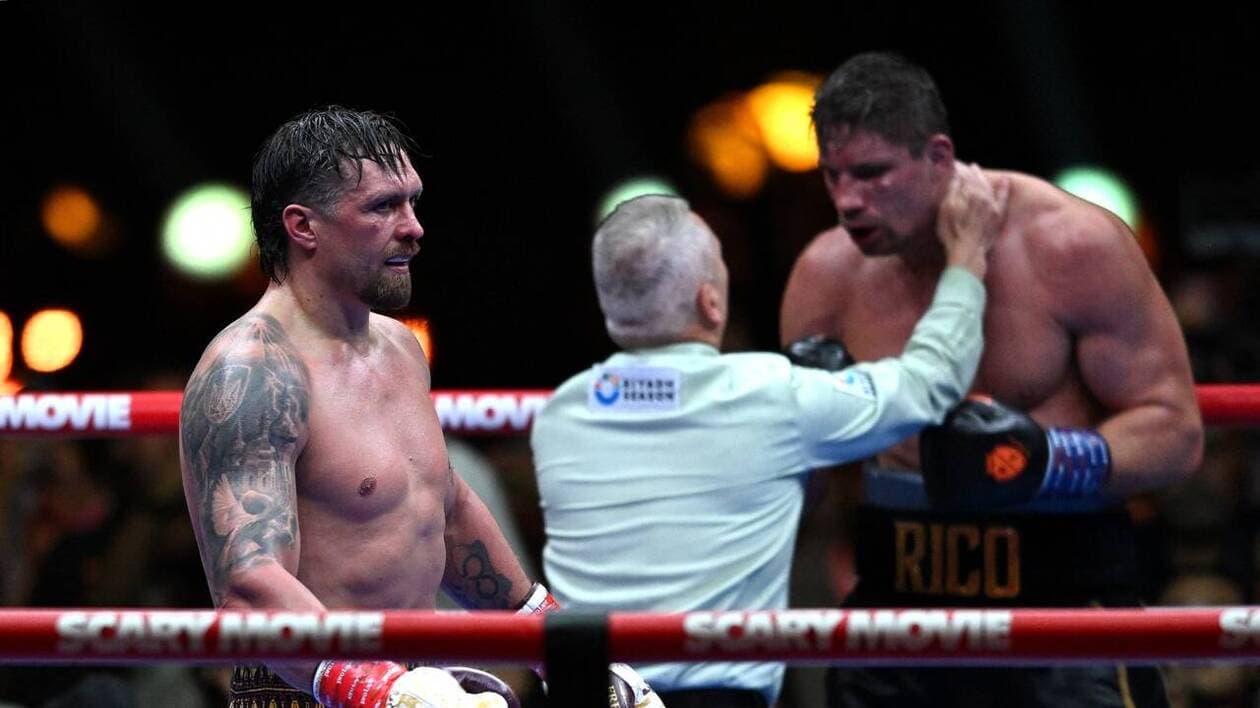
On Saturday, May 23, 2026, Oleksandr Usyk fought Rico Verhoeven. The matchup was surprising from the outset: Rico is a kickboxing legend with only one professional boxing bout roughly a decade ago. Usyk taking this fight made little sporting sense — he is near the end of his career, has already proved he rules the heavyweight division, and it was not an obvious money play either; in mainstream boxing, Rico was largely unknown. Yet what everyone expected to be an easy night for Usyk turned on its head. Rico is a serious physical problem: taller, heavier, impressively muscled, and he sustained a very high pace of movement and activity for the entire fight. From the opening rounds, his style recalled a bob-and-weave that heavyweights had not seen in a long time.
A reminder for those who may have forgotten: bob-and-weave, hugely popular in the 1950s and 60s, suited a different heavyweight body type — closer to 6 ft 3 in than 6 ft 10 in. Fighters used the upper body heavily, leaned forward, could bring their head down to the opponent's belt line and move low and to the sides to slip and provoke. With the head down around the opponent's midsection, the shoulder line sits in the middle of the visual field: it is hard to read whether the next shot will be a hook to the head or the body. A forward centre of gravity pushes on the opponent — a style that can look crude, but it worked in many fights of the 60s before fading away. It disappeared gradually as heavyweights grew taller (Foreman, Ali…): a low head means vulnerability to uppercuts; against longer opponents, you get picked off at range with the lead hand and punished with rear uppercuts. Rico probably did not adopt that technique consciously, but his approach resembled it: always forward, lunging at Usyk, shoulder line neither high nor low — Usyk struggled to read punches and was caught by hooks he did not see coming, which is striking for a fighter of his calibre. Rico was also clearly taller and heavier: Usyk could not dominate him physically, hold him at distance, or punish him with the rear uppercut. From the start, Usyk's lead uppercut seemed to be the only punch that really worked. Usyk must have assumed that Rico, with all that movement (legs, guard, torso) and that mass, would tire — except Rico did not tire. In the fourth or fifth round, an uppercut already hurt Rico; Usyk tried to capitalise, Rico held on. For the whole fight, Usyk was in deep trouble against a Rico who kept repeating the same pattern — and it kept working. Usyk is a very clever boxer, used to reading an opponent's style to counter it (Dubois, Tyson Fury…). Here, he did not find the right keys: jab, wait for the attack, finish with the hook — his usual playbook — but Rico's head, forward and low, sent many of Usyk's hooks sailing over; he did not follow today's orthodox posture. Many of Usyk's shots hit air; only the uppercut landed at times, and Usyk was too short physically to throw it while staying safe — not enough reach or mass to keep Rico at bay, and Rico clinched after his attacks to wear him down.
In the 11th round, late in the session, Usyk finally landed an uppercut that hurt Rico and put him down. That is when the buzz exploded — buzz that is almost funny, so much does it show how many live commentators, journalists, and social feeds no longer read the fight. With about a minute left in the 11th, Rico is on the canvas, gets up at the referee's count, and signals that he no longer has his mouthguard. Perhaps 40 seconds remain. The referee makes a bad call: he sends Rico to his corner to replace the mouthguard. Rico staggers; the coach puts it back in (it drops once, then is fitted again). Between the count of ten and the restart, easily 20 to 30 seconds pass. The fight resumes; Usyk pours it on, Rico does not answer, and the referee stops it after 5–6 seconds — the end-of-round bell sounds as the referee steps between them. Instant drama: "the referee robbed Rico because Usyk was losing." It is true that Usyk was behind on the cards (this writer would give him perhaps only two rounds in the whole fight). But the "robbery" logic does not hold: if the referee wanted to cheat for Usyk, why grant Rico more than 30 extra seconds of recovery when he was already unable to stand properly? With only the regulation ten seconds, Usyk would probably have finished him even faster. That is the major contradiction in the "robbery" narrative. The referee's real mistake was the corner time for the mouthguard. Then, an implicit correction by stopping the fight quickly after the restart — it happens in boxing, 11th round, decision fatigue. No robbery: Rico was hurt; less rest means a quicker end. Usyk was losing, yes — in trouble, without a lasting answer at range — but like a great champion he found his uppercut late in the 11th and closed the show. No scandal warranted: Rico was ahead, but winning in boxing means either a knockout or points over 12 rounds; Rico turned in 11 exceptional rounds, not 12. Tough luck for him, a hair's breadth from one of the greatest upsets ever; the emotion is understandable, the buzz is out of proportion. Usyk flirted with defeat — proof that anything can flip at the top, that invincibility eventually cracks (as may one day happen to Naoya Inoue). His record still stands today, but there is plenty to think about.
What about Rico's future: will this style work elsewhere? Probably not. Against someone like Tyson Fury or Anthony Joshua, taller men, Rico risks being held at distance and punished with uppercuts. His performance against Usyk comes from the overlap of a game already far from today's orthodox heavyweight style and a real morphological edge over a smaller Usyk. Against heavyweights bigger and longer than Usyk, Rico would very likely be knocked out quite easily.